


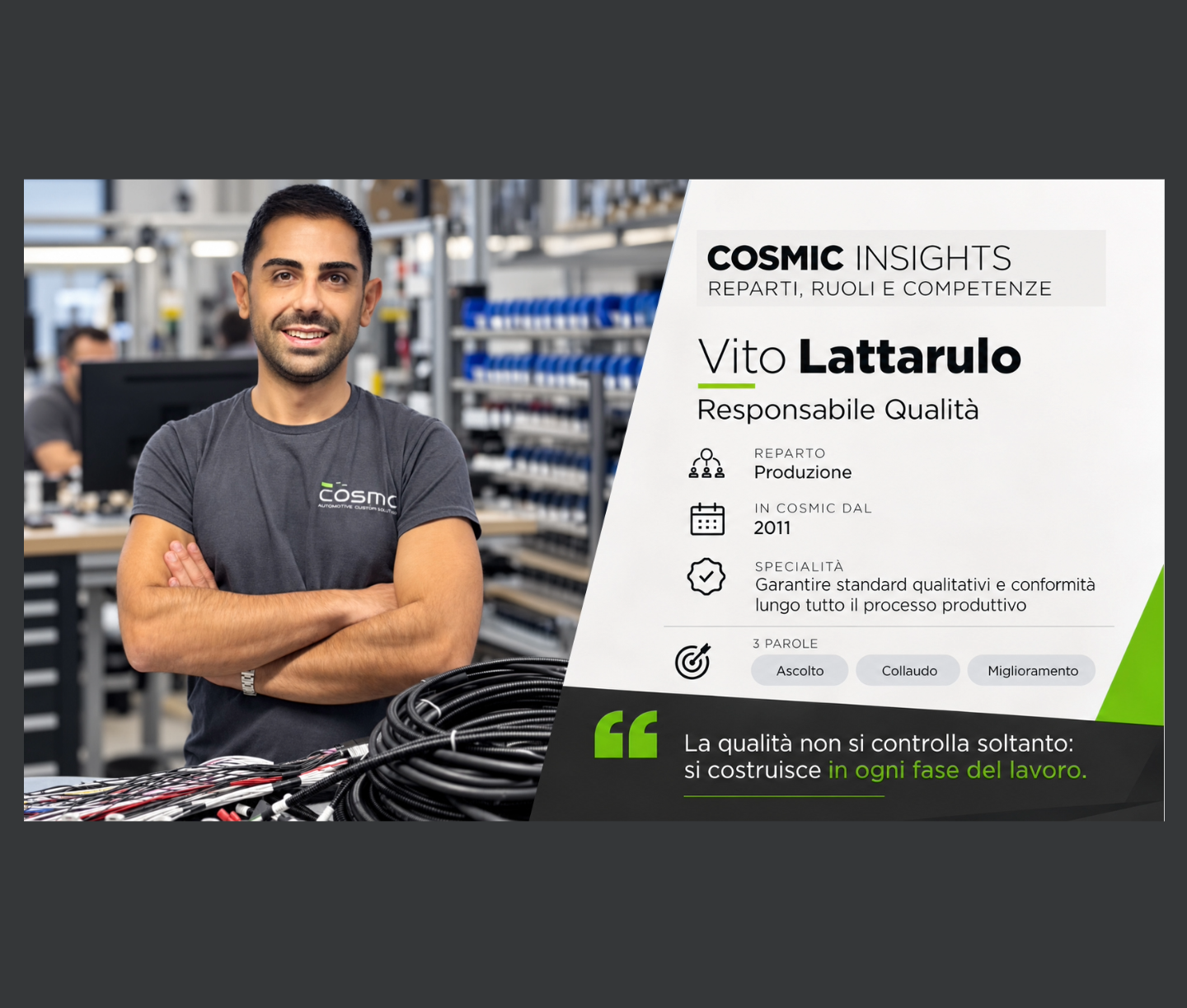
Inside Production: How quality is built
In the first article of COSMIC Insights, we stepped inside the warehouse to discover how materials management helps make the flow of materials to production more efficient.
Now our journey continues in another department, where precision, technical expertise and attention to detail are essential at every stage of the process: the Quality Department.
During visits to COSMIC, when looking at a wiring harness, an electrical panel or an integrated system, it is easy to focus on the finished product. But what checks lie behind that result? How do we verify that every connection is correct? And what happens when an anomaly is detected?
To find out, we meet Vito Lattarulo, Quality Manager at COSMIC since 2011, who takes us through the activities and inspections that help ensure products comply with project specifications and meet customer requirements.
“Where does quality begin?”
Quality begins with dialogue with the customer: listening to their needs, discussing expectations and translating them into practical decisions at every stage of the production process.
“The first step is to understand what the customer expects and what their needs are. From there, we can identify the most suitable solutions and organise the work accordingly. We use specific equipment for each area and rely on specialised personnel, carefully monitoring every stage to ensure that the final result meets what has been agreed.”
This dialogue does not end at the initial stage. It continues throughout the process, helping keep objectives, production activities and the final result aligned. Because quality depends not only on how a product is made, but also on the ability to understand the customer and turn their requirements into a tangible result.
Quality, therefore, is not just a final inspection: it is a commitment that accompanies the entire process from the very beginning.
“Which details make the difference in a wiring harness?”
We step into the wiring harness production area. To someone unfamiliar with this work, two wiring harnesses may look identical. In reality, each one must meet precise requirements based on the vehicle or machine in which it will be installed and the function it is designed to perform.
“We assess the vehicle or machine in which the wiring harness will be installed, the connections and the cable's current-carrying capacity, taking into account the equipment to be operated by the machine and its maintenance requirements.”
Producing a wiring harness therefore requires careful consideration of its application, the necessary electrical characteristics and the connections specified in the project.
These factors guide the technical decisions and determine the requirements the finished product must meet.
A wiring harness must not simply be well made: it must be suitable for its intended application and meet the required specifications.
“How do you verify that a wiring harness is ready for the customer?”
Once production is complete, the wiring harness is transferred to a dedicated testing area. This is where the test bench comes into play, allowing us to verify that all connections have been correctly made.
“The wiring harness is transferred to a dedicated testing area, where we use a test bench to check continuity and insulation, ensuring that all connections have been correctly made in accordance with the design schematic.”
Continuity testing verifies that the specified electrical connections have been properly established. Insulation testing, in turn, checks another essential characteristic of the wiring harness—one that cannot be assessed through visual inspection alone.
The project schematic is always the reference point against which the correct execution of the connections is verified.
These checks help identify any anomalies before the product reaches the customer.
“What happens when a problem is detected?”
Inspection is not just about confirming that everything is correct. It is also a way to identify critical issues and determine how to address them.
“If an anomaly is detected, the test bench identifies which connection needs attention. We then activate an internal process based on the 8D methodology to investigate the root cause and resolve the issue collaboratively, ensuring that it does not happen again.”
The goal is therefore not simply to correct an individual error, but to understand what caused it and take action to improve the process. This requires discussion and collaboration, because improvement comes from bringing expertise and information together.
Identifying an error is important. Understanding why it occurred and preventing it from happening again is even more important.
Quality Is built together. It does not end with the testing phase, but is an integral part of everyday work and contributes to continuous improvement.
